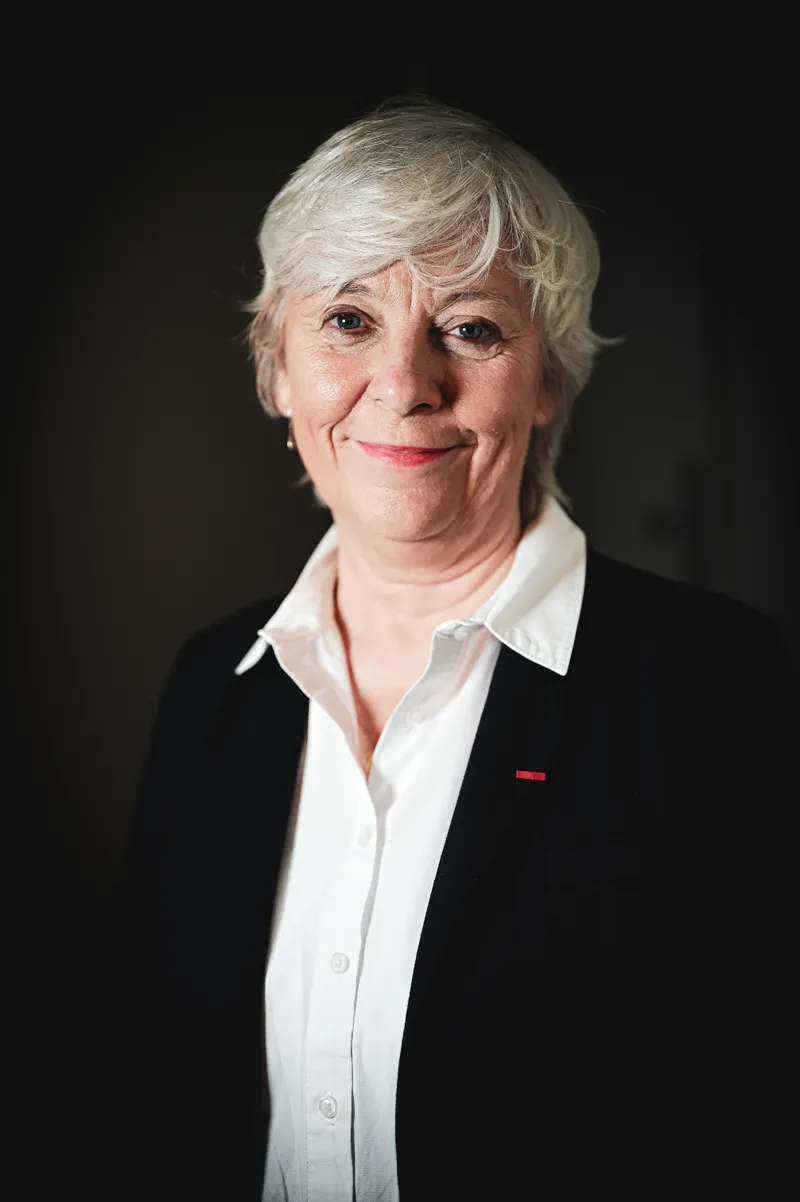
Doctorate in Anthropology (HDR). Research associate at the Centre National de la Rechercche Scientifique (CNRS).
Distinction: Knight of the Legion of Honour 2024.
I hold a doctorate from the University of Bordeaux and a habilitation to direct research from the EHESS, I am a research fellow at the Centre National de la Recherche Scientifique (CNRS) Groupe Sociétés Religions Laïcité (GSRL) laboratory, a joint EPHE/CNRS research unit, on the Condorcet campus of Paris Sciences et Lettres Université (Aubervilliers)
In 2024 I created the CERIF (European Centre for Research and Information on Brotherism) co-organiser of an international scientific conference on Islamisms in Europe (Paris 15 May 2024).
Anthropologist Florence Bergeaud-Blackler has been conducting research on Islam in a secularised context for over thirty-five years. Her work is characterised by a progressive and cumulative approach, focusing on concrete practices, ordinary actors and the mechanisms through which religious norms are disseminated in liberal societies.
Her early research focused on contemporary forms of Muslim religiosity and the production of norms outside traditional religious institutions. Very early on, she observed that these norms also circulate through channels rarely studied by the social sciences: the economy, the market and consumption.
Contrary to the dominant approaches, which approach halal almost exclusively from the angle of commercial opportunities, ‘diversity’ or economic integration, she was one of the first to analyse the halal market as a total social fact. She shows that halal is not just a label or a market segment, but a tool for religious normalisation, identity structuring and collective mobilisation. This perspective leads her to study the mechanisms by which religious prescriptions become part of modern economic logic, and vice versa. She analyses how the market can become a vector for normative dissemination, and how religious actors invest the tools of contemporary capitalism to transform social practices. In this context, she looks at the processes of Salafi indoctrination - whether fundamentalist or political - and how they relate to market, neoliberal and post-modern logics. It highlights the formation of halal ecosystems, in which economic offers, religious discourse and strategies of influence are combined.
This work finally leads her to a global analysis of the Muslim Brotherhood in Europe. In Le brotherism et ses réseaux (Odile Jacob), she proposes the concept of brotherism to designate a specific form of Islamism developed from the 1960s onwards in liberal democracies. This ideology does not primarily aim to seize political power, but to gradually transform societies through cultural, economic and social means. The brotherism is, in her view, neither a theological doctrine nor a legal school but a system of action. It is a structured transnational movement, oriented towards a long-term objective: the establishment of an Islamic society on a global scale. Florence Bergeaud-Blackler offers an analysis structured around three fundamental dimensions - Vision, Identity and Plan - which enable us to understand its coherence, its capacity to adapt and its concrete effects in contemporary secularised societies.